
Executive Coaching
When does leadership ever allow you enough time and space to think?
The more responsibility you carry, the more people look to you for answers. Yet some of the most important leadership questions aren't answered by thinking faster. They require the space to notice what is happening — in the situation, in others, and in yourself.
Eponathelia Executive Coaching creates that space.
We don't tell you how to lead. We aim to help you examine how you already do — the assumptions you make, the patterns you repeat, the impact you have and the choices available to you.
Greater awareness doesn't give you all the answers, but, it does give you a better place from which to decide which option you will choose.
What brings you here?
You've learned the leadership styles, attended the workshops and studied the frameworks.
But, deep down, there's a small voice telling you that something is missing.
Or, you've encountered a situation that doesn't fit neatly into any of the scenarios you've been taught.
The framework doesn't quite fit.
None of the usual answers address the problem.
And, what you need may not be another model to follow, but the time and space to examine what you're seeing, question what you're assuming and consider what you could do next.

A Different Kind of Conversation
How many times have you asked for help and been given things to do, plans to follow, or the answer that the other person believes is correct?
How often have you remembered those things when the pressure ramps up?
Eponathelia works from a different place.
We believe information is retained more permanently when you discover the answers for yourself.
So, instead of telling you the answers or giving you plans and procedures to follow, we listen. We ask questions. We challenge your thinking. We encourage you to look at the situation from different perspectives and examine the assumptions that may be influencing what you see.
Sometimes, we'll ask another question.
Sometimes, we'll give you the space and the silence to allow you to think.
And, sometimes, you'll hear yourself say something that you hadn't realised you were thinking.
The purpose isn't for you to leave knowing what we think you should do.
It's for you to leave with a clearer understanding of what you could do.
The answer remains yours.

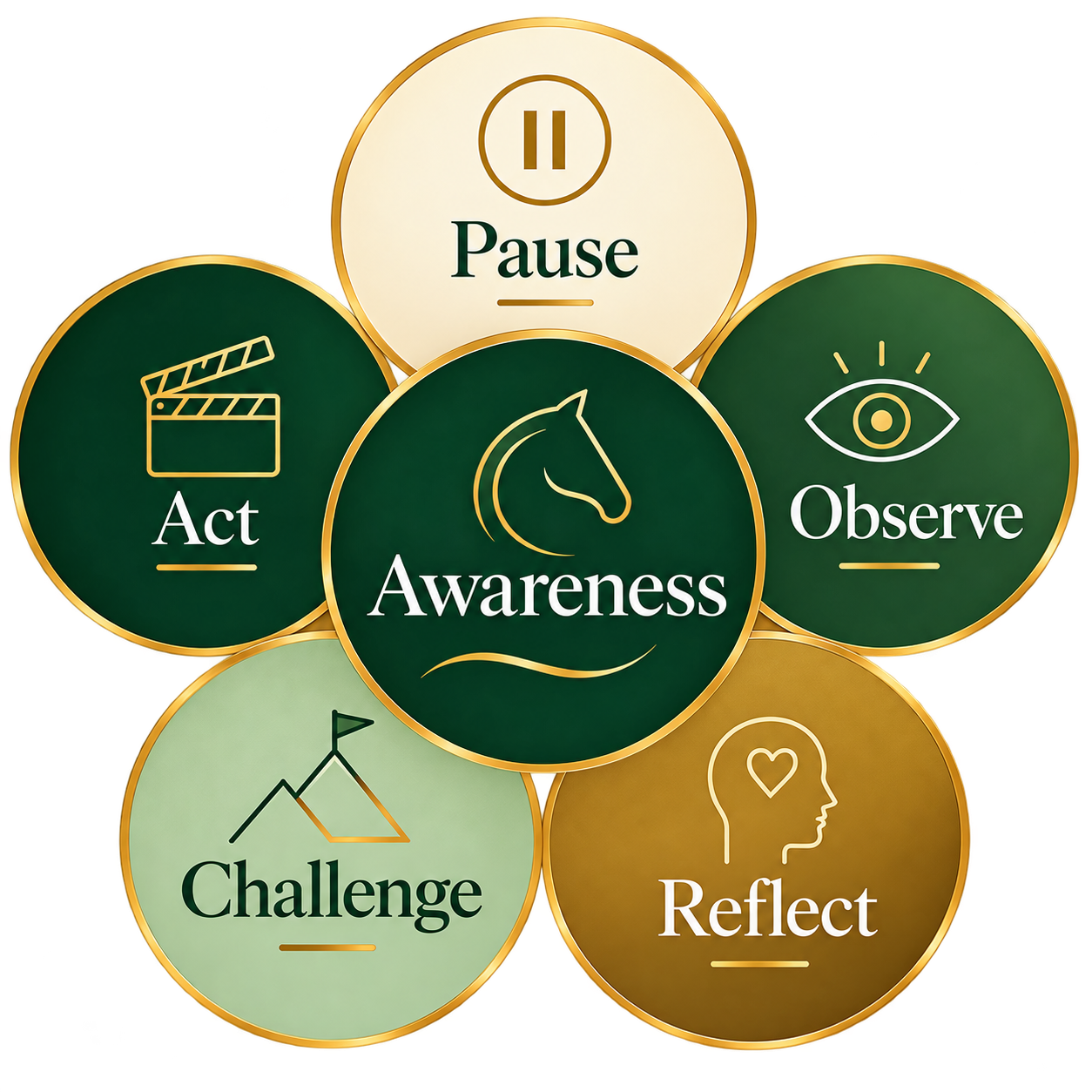
The Eponathelia Reflection Pathway™ in Coaching
Every conversation will be different, because every situation, every leader and every decision is different.
But, our approach is grounded in the Eponathelia Reflection Pathway™:
PAUSE → OBSERVE → REFLECT → CHALLENGE → ACT
PAUSE
Create the space to step away from the immediate pressure to respond.
OBSERVE
Look at what is actually happening. What are you noticing in the situation, in other people and in yourself?
REFLECT
Explore what those observations are telling you and consider the impact of your own thinking and behaviour.
CHALLENGE
Question the assumptions you are making. What else could be true? What haven't you considered? What changes when you look at the situation differently?
ACT
Decide what you want to do next.
The pathway isn't a set of instructions to follow, and we won't force every conversation through five prescribed stages.
It's a way of creating enough distance from the immediate situation to see it more clearly — before deciding what you want to do about it.
What Does Working Together Look Like?
Executive coaching should fit around the reality of your role, not become another demand on your time.
We begin with a conversation.
The initial conversation is free of charge and carries no obligation to continue. It is an opportunity to understand what has brought you to coaching, answer any questions you have and decide whether working together feels right for both of us.
If you decide we can work together, coaching can take place in person or online. In-person sessions are normally 90 minutes, while online sessions are normally 60 minutes.
Whichever format you choose, we encourage you to protect some additional space around your session where possible. With in-person coaching, that means allowing time to arrive without rushing and to take time to reflect before returning to your day. With online coaching, it means resisting the temptation to move immediately from coaching back into emails, Teams meetings or the next task on your list.
Give yourself time to consider what you've noticed, what has challenged you and what you want to do with it.
The session may have ended but your reflection should continue.
We'll agree the shape of the coaching relationship before we begin, including how often we meet, what you want to explore and how we'll review progress along the way.
Your priorities may change as our conversations develop. Something that seemed important at the beginning may become less so. Something you hadn't considered may emerge.
That's part of the process.
You won't be pulled back to a plan simply because it was the plan we started with.
We'll continue to listen, question and challenge, while allowing the focus of our conversations to respond to what you are noticing and what you need to explore.
And, when the coaching has given you what you came for, we bring it to a close, but remain available to you in the future, should you want to explore further or have more questions.
Confidentiality
For coaching to be valuable, you need to be able to speak openly.
What you share during your coaching sessions remains confidential.
If your organisation is funding your coaching, we will agree from the outset what, if anything, will be shared with them. You will know what those arrangements are before the coaching begins.
Details of conversations, questions asked, the situations you explore or the conclusions you reach will not be reported without your agreement.
Where progress is reviewed with a sponsoring organisation, we'll agree with you in advance what that review will cover and how it will be communicated.
Your coaching conversations are your space.
About Your Coach
Eponathelia Executive Coaching is delivered personally by Amanda Woods FCMI, a Fellow of the Chartered Management Institute, with more than two decades of experience spanning leadership, management, operations, business and people development across public and private-sector organisations.
Her career has taken her from operational and business management roles to leading teams, developing people and coaching managers and aspiring leaders across the Civil Service.
Amanda's approach to coaching is grounded in practical experience. She understands that leadership doesn't happen in a textbook. It happens when priorities compete, difficult conversations need to be held, people behave unpredictably, decisions have consequences and the methods and frameworks you were taught don't quite fit the situation in front of you.
She won't tell you what kind of leader you should be.
She'll help you explore the leader you already are — and recognise the leader you choose to become.
Start a Conversation
If you'd like to explore whether Eponathelia Executive Coaching is right for you, let's talk.